
Walk Casa Grande Streets by Address
A reliable Casa Grande street directory search follows the record keys, not just the text printed on a mailbox. The physical address leads to a parcel number, or APN. That number leads to the parcel shape and legal description. The legal description then links the property to recorded deeds, plats, and older address evidence. Work one parcel at a time when the goal is a full named street.
- Enter the street number and separate street components in the Pinal County Parcel Search. Save the APN, owner, property location, tax mailing address, subdivision, and legal description.
- Open the APN in the Pinal County Assessor Parcel Viewer. Pan along the street and click each parcel rather than assuming that consecutive numbers share the same lot pattern.
- Compare the owner and mailing fields in the Treasurer inquiry. Treat them as tax correspondence data, not a list of occupants.
- Search the owner and legal description in Acclaim. The acquisition deed names seller and buyer; repeat backward with each former owner.
- For historic occupancy, check surviving reverse street indexes, census schedules, newspapers, and other dated sources. Use voter information only through its authorized route.
This Casa Grande chain keeps three tracks apart: present title, transaction history, and named occupancy. A match grows stronger when two independent sources agree on a person, parcel, and date. One parcel card alone proves ownership on the assessment roll, not who is inside the home.
Search Casa Grande Streets by Parcel
The Casa Grande assessor form is the street directory starting point because it accepts more than a full address string. Surname-first owner searches help when the address is unknown. Subdivision and plat references help when road text has changed. Rural parcels can be found through section, township, and range. Keep the address pieces apart so a direction or street type does not block a valid result.
| Assessor field | Entry style | Best street use |
|---|---|---|
| Owner name | Last name, then first | Find titled parcels for a known owner |
| Street number | Number only | Anchor one physical property |
| Direction, name, type | Separate controls | Broaden or narrow a named street |
| Book, map, parcel, suffix | APN components | Return to the exact parcel |
| Subdivision name | Subdivision text | Group lots under one recorded plan |
| Section, township, range | Three selections | Find rural land without a stable street |
| Cabinet, slide, lot | Plat references | Connect a mapped lot to its plat |
The returned Casa Grande county details may include parcel size, tax area, primary owner, a second name, property address, tax-bill mailing address, value or class, zoning data, and links to the map. Capture the APN and legal description before leaving the result. They are safer continuity keys than a spelling alone.
For a whole Casa Grande street, repeat the same capture fields for each parcel and note vacant or nonresidential lots without trying to force a resident name onto them. If the public interface does not expose a prior assessment year, ask the Assessor for the specific roll year and APN. The Casa Grande branch at 820 E Cottonwood is open Monday through Thursday from 8:30 to 3:30, and the office phone is 520-866-6361.
Map Casa Grande Streets in GIS
The Casa Grande GIS viewer supplies the spatial part of a by-street search. It shows parcel polygons, so a researcher can inspect the lots beside and behind a target. The Pinal County GIS hub also points to zoning, flood, school district, voter district, comprehensive-plan, delinquent-tax, and justice-precinct viewers. Those layers define administrative facts. They do not identify a household.
The official parcel viewer shows the map interface used for Casa Grande property research.
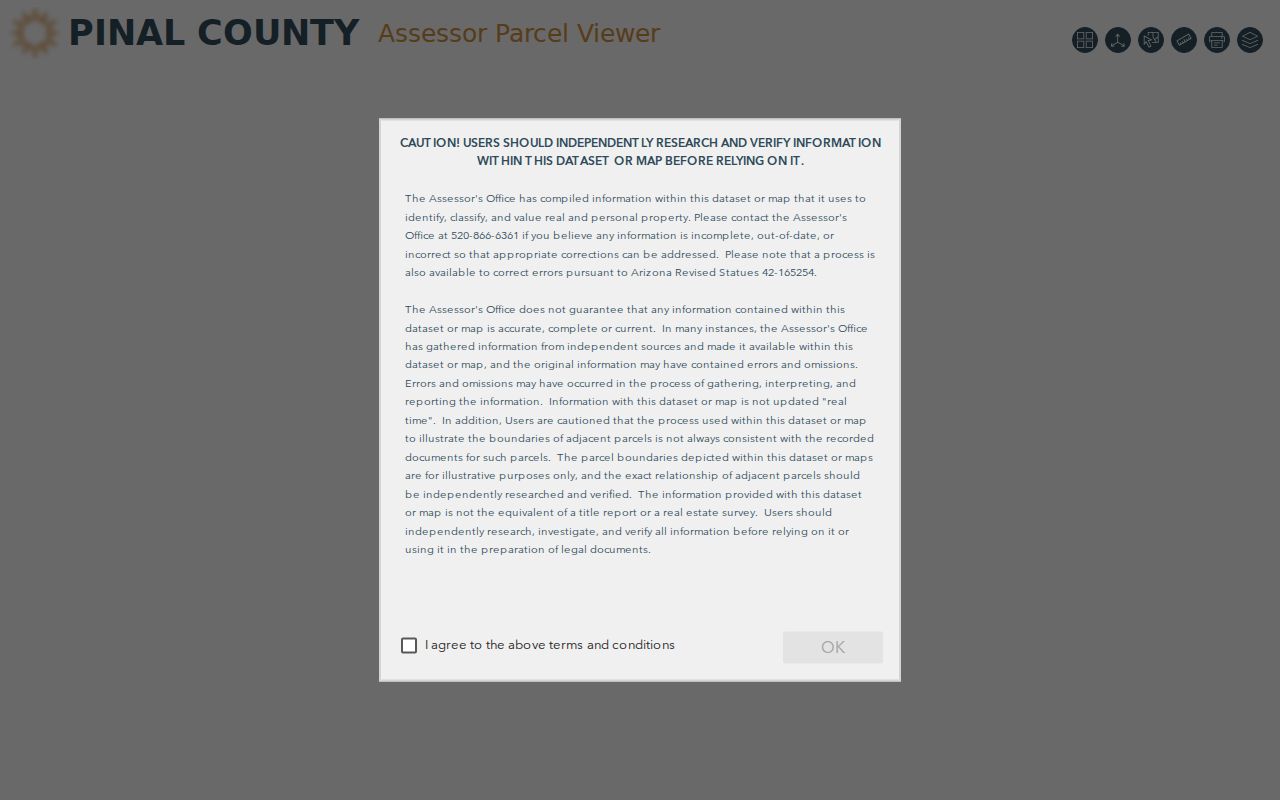
The screen connects a street segment to individual parcels. Copy each linked APN, then return to the assessor rather than reading ownership from map position alone.
Note: The public viewer confirms parcel relationships, while the assessor card remains the source for current roll fields tied to each APN.
Compare Casa Grande Street Records
No single record set is a complete Casa Grande address index. The assessor and GIS are the best route from address to parcel. The Treasurer adds tax-mail data. Recorded instruments identify transaction parties. City permits can document work at a known address. Printed directories add dated residents when an edition and street index survive.
| Address source | Record keeper | Street evidence | Access route |
|---|---|---|---|
| Parcel roll | Pinal County Assessor | Owner, situs, mail, APN, legal description, class | Free web search; Casa Grande branch; phone; focused written request |
| Parcel geometry | Pinal County GIS | Lot shape, adjacent parcels, mapped layers | Free interactive viewer |
| Tax account | Pinal County Treasurer | Tax owner, mailing data, bills, payments | Free nightly-updated search and CSV export |
| Deeds, plats, easements | Pinal County Recorder | Parties, legal land text, recorded transaction | Acclaim from 1980; branch, Florence, email, or mail earlier |
| Permit file | Casa Grande Development Center | Project, applicant, inspection, possible owner authorization | Known permit online; address request through Development or Clerk |
| Printed directory | State Research Library and local history sources | Dated listed person at an address | Digitized 1960 volume; intermittent shelf in person |
Older Casa Grande context may also come from Sanborn sheets, newspapers, census schedules, territorial lists, and great registers. If an online portal fails, the chain continues at a counter, by phone, through a focused written request, or at the library and archives.
Separate Casa Grande Situs and Mail
Pinal County makes a useful distinction that many quick address searches blur. The property location is the situs address, meaning the physical parcel. The tax-bill address is where correspondence goes. It may be a different home, an office, a post-office box, or an out-of-area destination. That second address can help locate an owner, but it cannot show where the owner lives.
- Parcel
- A separately identified unit of land on the county roll, usually tracked by an APN.
- Situs address
- The physical location assigned to the property, distinct from the tax mailing destination.
- Plat
- A recorded map that divides land into lots, blocks, tracts, streets, or easements.
- Criss-cross directory
- A directory section arranged by street and house number instead of by surname.
Casa Grande property class is also limited evidence. A primary-residence or non-owner classification can suggest how the roll treats the parcel, but it supplies no list of family members or other occupants. Keep the county’s field labels verbatim in research notes so situs and mail are not merged later.
Follow Casa Grande Street Deeds
After converting a Casa Grande address to APN and legal description, search the Pinal County Acclaim index. It offers Name, Fee Number, Document Type, Record Date, Doc Legal, and Docket/Page modes. A fee number is a permanent recording key. Doc Legal is often the best bridge when an old instrument lacks the current street wording.
For Casa Grande records, Acclaim reaches from May 23, 1980 to the present. The Recorder scans public images, indexes key facts, preserves archival microfilm, and returns originals. Online PDFs carry an unofficial-copy watermark. For a certified result, request the document from the Recorder. Ordinary copies are $1 per page, with $3 more for certification per document.
The Recorder’s official access and fee explanation documents the cutoff and request choices.
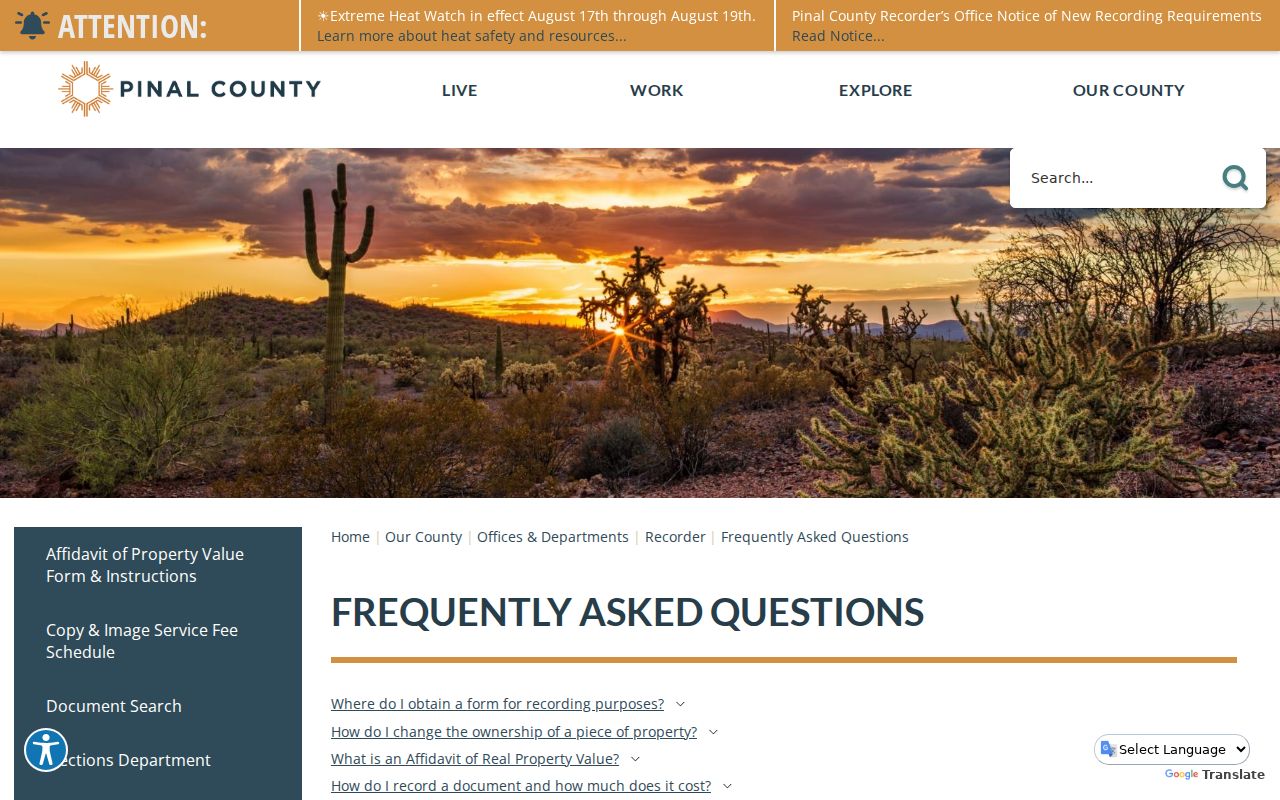
The Casa Grande online date is a portal limit, not the start of county land records. The Recorder office list places the Casa Grande branch at 820 E Cottonwood Lane, Suite A-2, 520-866-7483, weekdays 8 to 4:30; the Florence office handles deeper microfilm questions. Email, mail to P.O. Box 848, Florence, AZ 85132, and focused county requests are also documented channels. When a name search fails, test each spelling, narrow the date, switch to Doc Legal, and search the seller as a prior grantee. Require the same legal description before joining two transfers.
Request Casa Grande Address Permits
Casa Grande WebPermits is not a street-browse index. Its visible form requires a permit number and then supports inspection results or scheduling tasks. A blank result without that number says nothing about whether an address file exists. The practical fallback is the Development Center at 510 E Florence Boulevard or the City Clerk.
Give the exact Casa Grande situs, APN, permit type, and an estimated date. Ask for named existing items such as the application, owner authorization, inspection result, and certificate or final. Planning and Development can be reached at 520-421-8630 on weekdays from 7:30 to 5. During the city portal transition, written public-record requests go by email to the Clerk. This focused wording avoids asking staff to create a new, broad street compilation.
Note: Permit records may name an owner, applicant, project, contractor, dates, and inspections, but protected fields can still be redacted.
Test Casa Grande Street ZIP Aliases
Casa Grande postal history can break an otherwise sound street search. In 2007, USPS split deliveries from 85222 into 85293 and 85294. A later regional prefix conversion produced 85193 and 85194. Old deeds, directory entries, notices, and newspaper OCR may therefore attach different ZIP forms to the same place.
Search the historic forms 85222, 85293, and 85294 alongside modern 851 forms. Yet ZIP never replaces jurisdiction. USPS delivery areas, Census ZCTAs, and Casa Grande city limits differ. Verify the full current mailing form with USPS, then use the parcel viewer to check municipal and county geography. When a text search still fails, the APN and legal description carry the property across the postal change.
Reverse Casa Grande Directory Years
Historical Casa Grande occupancy belongs to a different evidence track. Verified Casa Grande directory holdings are intermittent from 1960 through 2000, and the digitized 1960 Mullin-Kille edition includes street-index and address clues. A criss-cross section turns the lookup around: find the street, scan house numbers, and record the listed name for that edition.
The Casa Grande shelf does not run every year. A missing entry can mean a move, an unlisted household, a canvass gap, or a missing volume. Pair nearby editions with the 1950 census, deeds, newspapers, and historical maps. The full collection and entry conventions belong on the Casa Grande city directory page; for street work, keep only the edition, printed address, name, and page image needed to date occupancy.
Casa Grande Voters Are Not Streets
For Casa Grande searches, the Arizona Voter Information Portal is an authenticated self-service tool, not an anonymous block directory. Its status mode asks for county, last name, date of birth, an identification method, and the matching number. A separate residence-address mode finds polling information. Neither one displays everyone along a block.
A.R.S. §16-168 governs purpose-limited Casa Grande voter-file access through the Recorder. Some file fields can include a residence and different mailing address, but sensitive identifiers remain withheld, protected voters can be suppressed, and authorized copies carry use and redistribution limits. Historical research has a distinct route through Pinal great registers from 1876 to 1920. A no-match online may reflect exact-ID mismatch, inactivity, nonregistration, or protection, not proof that a person did not reside at the address.
Limits of Casa Grande Street Records
A modern Casa Grande owner list is not a household list. Other occupants and household members usually do not appear on the parcel roll. Tax mail may go elsewhere. DMV personal data is closed by federal law. Utility, alarm, and delivery rosters are not public street directories. Arizona protected-address programs can also remove or shield information in voter, recorder, assessor, and Treasurer systems.
Use Casa Grande public records for lawful family, property, civic, or historical research. Preserve uncertainty when the sources disagree. A directory entry is a dated association; a deed is a recorded transaction; a parcel roll names an assessed owner. None of those facts should be stretched into continuous occupancy.
Lawful use. Casa Grande address records must not be used to stalk, harass, threaten, or evade a protected-address program. Stop when a custodian marks information sealed or confidential.